

Since taking office in 2022, I have had the honor of serving as Deputy Minister of Health at a time when Somalia’s health system faced both unprecedented challenges and immense opportunities. From recurrent droughts and pandemics to a legacy of underinvestment, we knew the task ahead required more than service delivery—it required rebuilding trust in our institutions.
Today, I am proud to share that Somalia is making real progress.
In April this year, we introduced two life-saving vaccines into our routine immunization program: the pneumococcal conjugate vaccine (PCV) and the rotavirus vaccine. These vaccines will drastically reduce child mortality caused by pneumonia and diarrheal diseases—two of the leading killers of Somali children under five. In the same month, we launched a measles catch-up campaign to close dangerous immunity gaps left by years of insecurity.
Earlier in February, we led a nationwide polio vaccination campaign that reached over 2.5 million children under the age of five. The campaign targeted high-risk districts with the new oral polio vaccine, marking another milestone in our journey to eradicate this paralyzing disease from Somalia for good.
We also turned our attention to infrastructure. In May, we launched solar electrification projects in all referral hospitals in every state, ensuring health centers have 24/7 access to clean power for cold chain storage and emergency care in Mogadishu. This is more than health—it is a foundation for quality healthcare delivery.
But service expansion is only part of the vision. We invested in knowledge and policy. For the first time in our history, the National Blood Bank, the National Drug storage, the National Cold chain, also Somalia held a National Health Research Conference and launched the Somali Health coordination. This platform gives Somali researchers and policymakers the tools they need to lead with evidence—not guesswork.
We also signed onto the global Countdown to 2030 initiative. Through this partnership, we are tracking indicators in reproductive, maternal, newborn, child, and adolescent health—ensuring that data drives every dollar spent and every policy passed.
Another key milestone was the development of Somalia’s first-ever National Medicine and Drug Safety Policy. By establishing traceability, inspections, and response protocols, we are not only protecting public health but preparing our systems for international trade and regulatory compliance.
These achievements reflect a broader shift. Somalia’s health system is no longer in survival mode. We are building a system of confidence, of competence, and of compassion. One that protects the vulnerable, empowers health workers, and earns the trust of the Somali people.
As we move forward, we must remember: good health is not a privilege for the few—it is a right for all. And with the right leadership, it is a goal within reach.
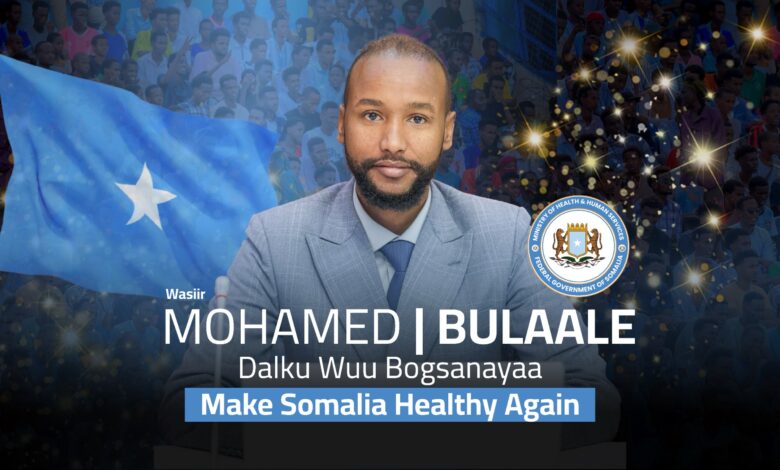
Hon. Dr. Mohamed Hassan Mohamed Bulaale is the Deputy Minister of Health and Human Services for the Federal Government of Somalia.
By Hon. Dr. Mohamed Hassan Mohamed Bulaale
Deputy Minister of Health and Human Services, Federal Government of Somalia